
Water Damage Estimator for Jacksonville Homes
Eight quick questions about the water in your Jacksonville home. The result gives the likely water category and drying class, a range of drying equipment, the lines a written estimate should include, first steps, and a short script for the phone call. It is an estimate of scope, not a quote, and it shows no prices.
It works from the categories and classes in the ANSI/IICRC S500 Standard for Professional Water Damage Restoration, the IICRC air mover worksheet, and EPA mold and humidity guidance. Your answers stay in the result page's address so you can print it; nothing is stored or sent.
The questions
- What's leaking? (AC or air handler leak, burst pipe or ceiling leak, slab leak, water heater or appliance, wind-driven rain, flood water from outside, sewage backup)
- How long ago did it start? (under a day, one to two days, two to three days, over three days)
- How much floor is wet, and in how many rooms?
- What kind of home? (single-story house, house with an upstairs, condo, townhouse or apartment)
- Do you own the home or rent it?
- The ZIP code of the home
- What got wet, if you know (carpet, wood, laminate or vinyl plank, tile on the slab, walls (drywall), kitchen or bath cabinets, a ceiling)
- Any visible mold? (none that I can see; yes, under about 10 square feet (3 ft by 3 ft); yes, more than that)
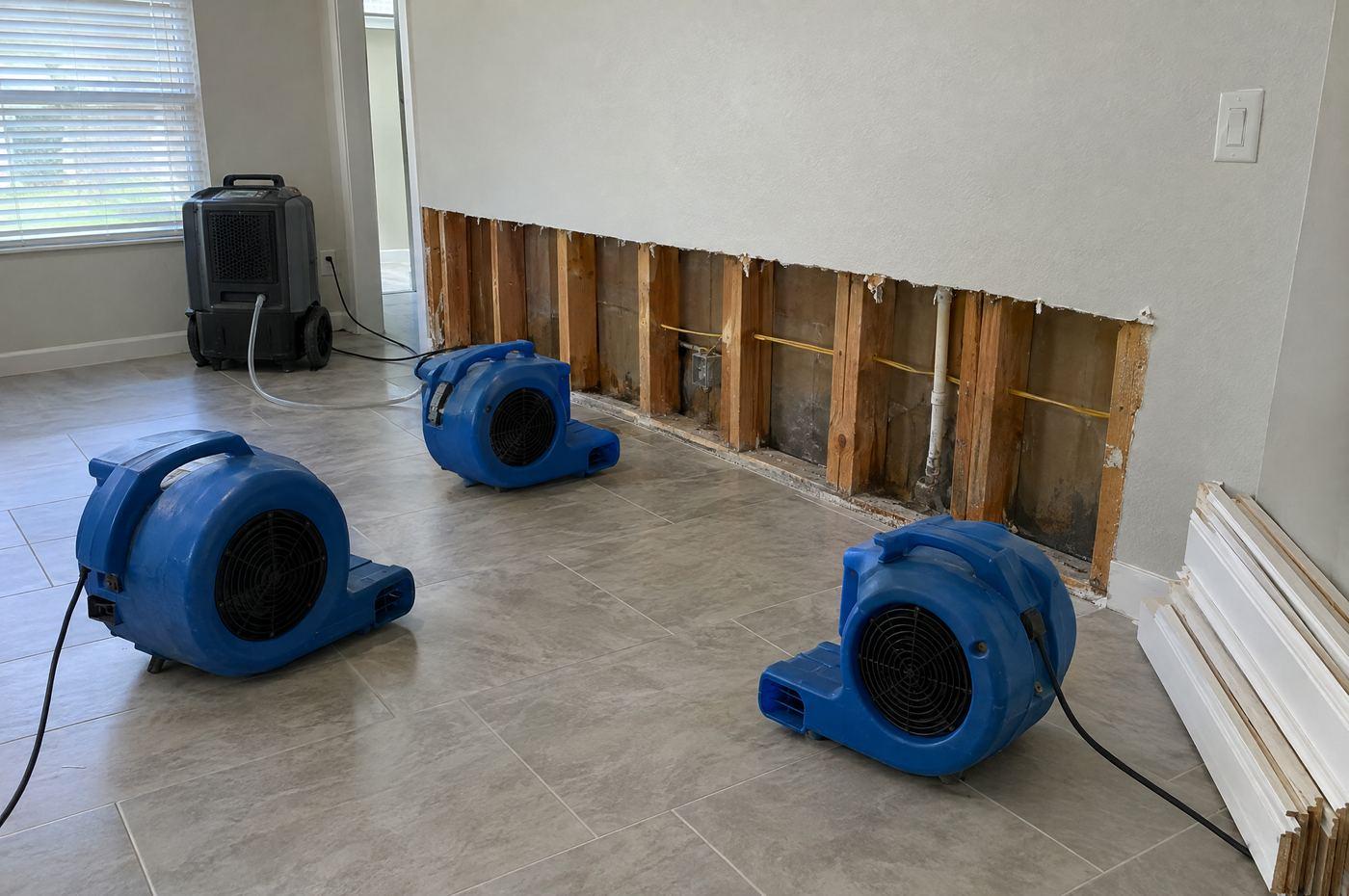
Worked example
A clogged condensate line under an attic air handler in a single-story Arlington house (32211) overflowed yesterday. Water came through the hallway ceiling and spread over about 220 square feet of carpet and the bottom of the walls in two rooms. No mold is visible yet.
- Category 1 water (clean source), probably Class 3 drying, since water came from above, so insulation and the walls below are probably wet as well.
- Roughly 6 to 7 air movers. The IICRC worksheet starts with one air mover per wet room and adds one for each 50 to 70 square feet of wet floor.
- Inside the EPA's 24 to 48 hour window, so drying should start today.
- The estimate should show ceiling and drywall removal only where the material can't dry, plus daily equipment and monitoring lines.
Sources: IICRC Airmover and Gallons Calculation Worksheet (rev. 7.1.22); EPA: A Brief Guide to Mold, Moisture and Your Home; ANSI/IICRC S500 Standard for Professional Water Damage Restoration.