
Slab leak water damage in Jacksonville
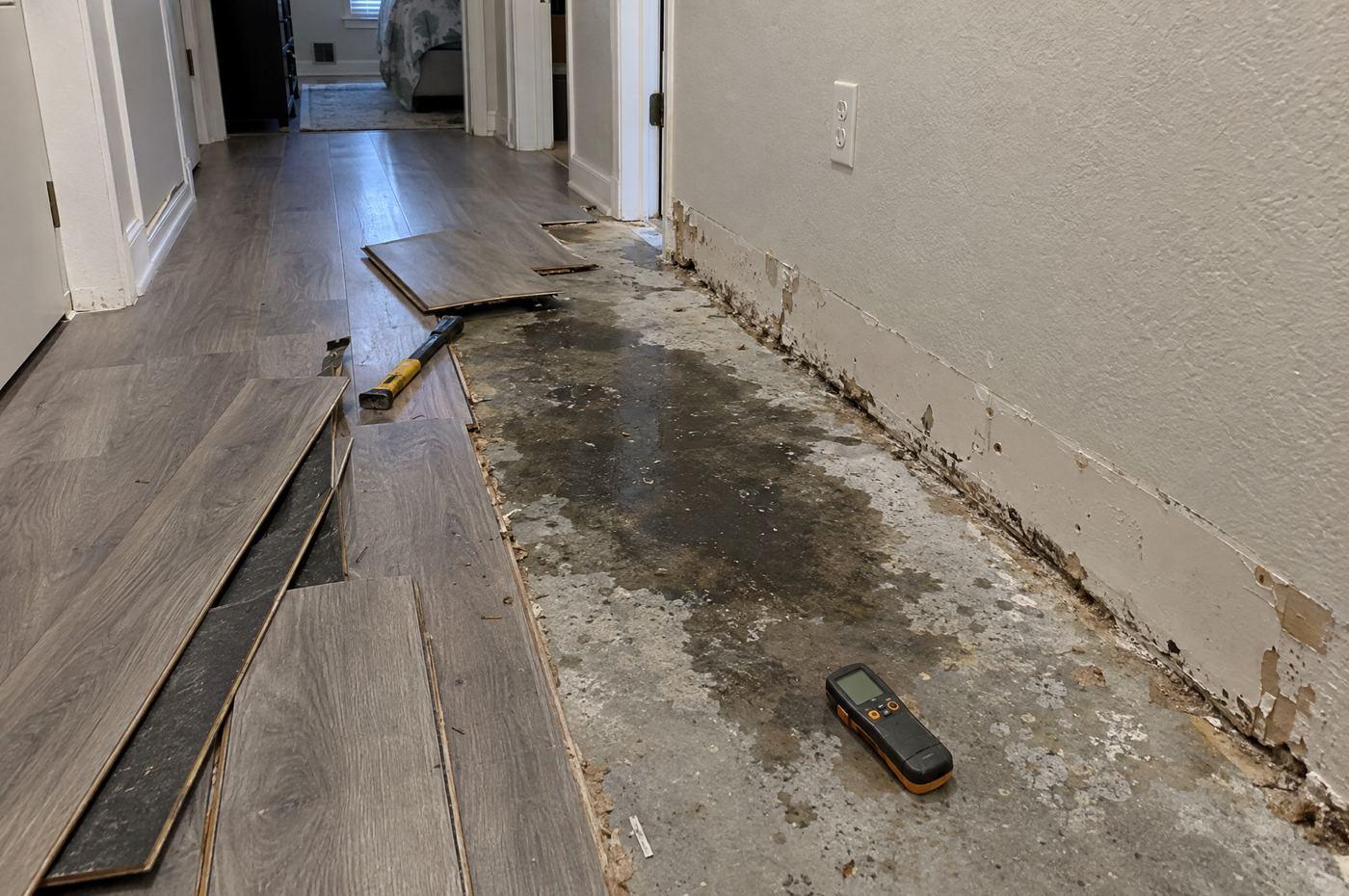
Most Jacksonville houses sit on a concrete slab, and copper or plastic water lines run through or under it. When one of those lines leaks, the water spreads under flooring, soaks the bottom of walls and can stay hidden for a long time.
The line is open 24/7 and connects you with an independent local company.
Right now
- 1Turn off every faucet and appliance, then watch the JEA meter for 15 minutes. If it moves, water is going somewhere.
- 2If the meter moves and you can't find a dripping fixture, close the main valve at the meter box until a plumber can test the lines.
- 3Note any warm spots on the floor, damp baseboards or cracked tile, and photograph them with the date.
- 4Keep foot traffic off flooring that is lifting or soft.
What's going on
A leak detection plumber finds and repairs the line. Drying the slab, flooring and walls afterward is a separate job, and it is the part this page is about.
Your JEA meter is the simplest slab leak test: with every tap and appliance off, the dial should stand still. A leak on the street side of the meter is JEA's; one on the house side is yours, along with the drying that follows.
Water category: Category 1 (clean water) from a supply line.
What changes the size of the job
- How long the leak ran unnoticed
- Flooring type over the slab and how much has to come up
- Whether the slab must be opened to reach the pipe
- How many rooms share the wet slab
No prices here: only a written estimate from the company that sees the house can give one.
How drying usually goes
- 1
Find the edges
Moisture readings across the floor and the lower walls show how far water has moved from the leak.
- 2
Lift what traps water
Laminate, engineered wood and carpet over a wet slab usually come up so the concrete can dry. Tile may stay if readings allow.
- 3
Open the lower walls
Baseboard and the bottom of drywall come off where readings are high, to let wall cavities dry.
- 4
Dry the slab
Concrete holds water for a long time, so dehumidifiers and air movers often run longer than for a surface spill.
- 5
Verify before flooring goes back
New flooring goes down only after the slab tests dry; trapping moisture under it invites mold.
Jacksonville facts for this problem
JEA says replacement costs from the meter to the home, and inside it, are the customer's; the meter box is typically at the curb near the street.
Source: JEA: Water Service Line Verification ProjectJEA asks owners of homes built before June 1986 to report their water service line material as part of a federal lead and copper inventory.
Source: JEA: Water Service Line Verification ProjectAbout 40% of homes in Jacksonville's 31 residential ZIP codes were built before 1980, by Census estimates; the median home in 32206 dates from 1947 and in 32222 from 2012.
Calculated by Jax Water Damage Hub: U.S. Census Bureau, ACS 5-year 2020-2024 (calculated)JEA lists (904) 665-6000 as a 24-hour number for severe sewage backup or significant water back-flow into a home.
Source: JEA: ContactEPA guidance: get wet materials and belongings dry within 24 to 48 hours, or mold can start.
Source: EPA: A Brief Guide to Mold, Moisture and Your HomeAny Florida contractor or mold license can be checked by name or number on the Florida DBPR license search.
Source: Florida DBPR license search
Insurance, in general terms
Policies often separate the cost to find and repair the leaking pipe from the water damage it caused, and some limit access costs such as breaking and patching the slab. Read your own policy before work starts.
Questions
- How do I know if I have a slab leak?
- Common signs are a warm spot on the floor from a hot water line, damp carpet or baseboard with no visible source, the sound of running water with every tap off, and a meter that keeps turning.
- Does the restoration company fix the pipe?
- Usually not. A plumber locates and repairs the pipe. The water damage company dries and removes damaged materials. Check whether each estimate includes the plumbing, the drying, or both.
- Can the floor dry without pulling it up?
- Sometimes tile over concrete can dry in place. Laminate, engineered wood and carpet pad usually trap water against the slab and have to come up.
Other water problems
Slab leaks in Jacksonville? The line is open now.
(904) 352-8877